
Why Finding the Right Clinical Supervisor is Your Most Important Career Move
You entered this field because you have a deep capacity for empathy and an intuition that allows you to see people in their most vulnerable moments. You wanted to make a difference. But somewhere between the high caseloads, the agency pressure to be productive, and the constant anxiety of wondering if you’re actually doing it right, you started to lose your footing.
Now, you’re looking at the next two plus years of your life as a Registered Clinical Social Worker Intern, and you’re faced with a choice. You can find a supervisor who just signs your hours and checks the boxes, or you can find a supervisor who helps you actually become the clinician you were meant to be.

My Top “Horror Films” as Trauma Therapist Who Works with Adult Children of Emotionally Immature Parents
Hearing someone say “but they’re your mom/dad…” when non one ever says to them ‘but that’s your child”
Deciding whether to keep it light or drop the most diabolical lore of your life when someone asks about them
Saying, “my childhood wasn’t that bad, it could’ve been worse”
Your parent trauma-dumping their life on to you, but calling you “dramatic” when you have a feeling….

When Your Parent Turns Your Boundaries Into an Attack
It starts with you saying a single, vulnerable sentence to your parent: “That really hurt my feelings.”
You aren’t looking for a fight; you’re looking for repair. You’ve probably spent days rehearsing this moment in your head, choosing the most gentle words and the perfect "calm" tone just to avoid a blow-up. But instead of the apology you deserve, the script flips.
Suddenly, your parent is the one in distress. To protect their own ego, they turn your boundary into an attack on their character. You hear the familiar, dramatic refrains:

"The Phone Works Both Ways!": Understanding the Guilt-Tripping Emotionally Immature Parent
You’re sitting on the couch, you’ve been there for five minutes, and your parent already starts: “I guess you forgot you have a mother. The phone works both ways!”
It’s exhausting. You came home to connect, but before you’ve even settled in, you already want to GTFO and you're stuck feeling like a “bad child.” If this scenario feels like a constant loop in your life, you aren't alone, and more importantly, you aren't actually the problem.
The Nuance: Why Emotionally Immature Parents Use Guilt
Your mom isn’t necessarily a bad person for saying this. She’s likely operating from her own unresolved abandonment and a complete lack of emotional tools. Instead of having the capacity to simply say, “Hey, I’ve really missed you, and I’m so glad you’re here,” she uses guilt to bridge the gap.
But here is the part you need to hear: You aren’t a bad person for feeling annoyed, drained, or like you’re doing something wrong.

Why Your Healing Can’t Wait for an Apology: Healing from Emotionally Immature Parents with EMDR
If you are reading this, you’ve likely spent years (maybe decades) searching for the "magic words” from your parents. You’ve curated your tone, waited for the perfect moment of calm, and delivered your feelings with the utmost gentleness, only to be met with a wall.
When you attempt to confront an emotionally immature parent (EIP) about childhood wounds or current boundaries, the response often falls into a predictable, painful script:
“I’m sorry you feel that way.”
“You’re just looking for reasons to be unhappy.”
“I guess I’m just a failure then.”
“I will never change, that’s just who I a.”
These statements are painful, but they are also data points. They tell you exactly where your parent’s emotional capacity ends. If you are waiting for them to finally “get it” so that you can move forward, you are essentially putting your well-being in the hands of someone who has already shown they cannot hold it.

Did I Have an “Emotionally Immature” Parent? 15 Signs and How to Heal
Did you grow up feeling lonely even though your physical needs were met? If you felt like the 'adult' in your relationship with your parents, you might have been raised by an emotionally immature parent. Check out the 15 signs of EIP and how to start healing the invisible wound today

Conversations with Healers, Helpers, & Guides: From Trauma to Transformation: Why I Help Others Heal Through Reiki and Holistic Care with Paty ‘Mariposa’ Hernandez, LCSW
Conversations with Helpers, Healers, and Guides is a monthly blog series from Holistic Healing and Wellness with Sabrina LLC to spark conversation with other wellness professionals to share perspectives on different ways mind, body, spirit health can be supported.
Today, we are talking with Paty ‘Mariposa’ Hernandez, a Licensed Social Worker, Reiki Master/Educator who is a wealth of information for mind-body-healing. I learned Reiki from Paty and am blessed to study with her and learn from her.

How Trauma Affects Your Crown Chakra (And How to Reconnect with Your Purpose)
Have you ever felt a sense of peace, a deep connection to something larger than yourself, or a clear understanding of your place in the universe? That quiet sense of knowing and belonging comes from your Crown Chakra. It's your highest energy center, linking you to spiritual wisdom, universal consciousness, and your true purpose. When it's balanced, you experience serenity, clear spiritual insight, and a feeling of unity.
But what happens when that vital connection feels fractured, especially after traumatic or deeply challenging experiences? You might find yourself feeling utterly lost, disconnected from any sense of meaning, or struggling with existential confusion. These are often signs that your crown chakra needs some gentle attention and healing.

How Trauma Affects Your Third Eye (And How to Reclaim Your Clarity)
Ever felt that "gut feeling" or just knew something was off, even if you couldn't explain why? That's your Third Eye Chakra at work – your inner compass for intuition, insight, and deeper wisdom. When this powerful energy center is balanced, it's like having crystal-clear vision for your life, allowing you to trust your instincts and see beyond the surface.
But what happens when that inner guidance gets cloudy, especially after difficult or traumatic experiences? You might find yourself constantly second-guessing, struggling with a persistent mental fog, or feeling completely disconnected from your own inner knowing. These are often clear signals that your third eye chakra needs some gentle attention and healing.

How The Chakras Are Connected to the 8 Phases of EMDR
You know, sometimes life just hands you experiences that lodge themselves deep in your bones. Even years later, a random smell, a sound, or even just a fleeting thought can zap you right back to that intense feeling – like your body's still holding its breath. It's not just "in your head"; that lingering tension, that fuzzy thinking, or that quiet hum of anxiety can genuinely throw off your whole rhythm.
As a therapist, I've seen countless times how EMDR (Eye Movement Desensitization and Reprocessing) therapy can gently unstick those moments, helping your system finally exhale. And here's something that just feels right when we talk about healing: connecting it to your body's natural energy centers – what many ancient traditions call chakras.
Imagine your chakras as these seven vital hubs of energy, flowing right through your core. Each one is a kind of blueprint for how you experience different parts of yourself – your sense of safety, your emotions, your voice, even your deepest wisdom. When they're all open and flowing, you feel like you again, connected and clear. But when trauma hits, it can snag that flow, leaving an imprint that makes you feel disconnected, anxious, or just plain heavy.
The deliberate steps we take in EMDR aren't just about processing old memories on a mental level. EMDR helps you on a somatic and emotional level.
They actually work hand-in-hand with these energy centers, helping you shift from those sticky negative beliefs that trauma often leaves behind (like "I'm not safe" or "I'm broken") to genuinely powerful, liberating positive beliefs (like "I am safe now" or "I am whole").
As an EMDR trained therapist, Reiki Master, and Yoga Teacher, I love weaving spirituality into trauma healing so that you can heal from the inside out. If you are someone who loves a holistic approach and craving something deeper, this blog post is for you!
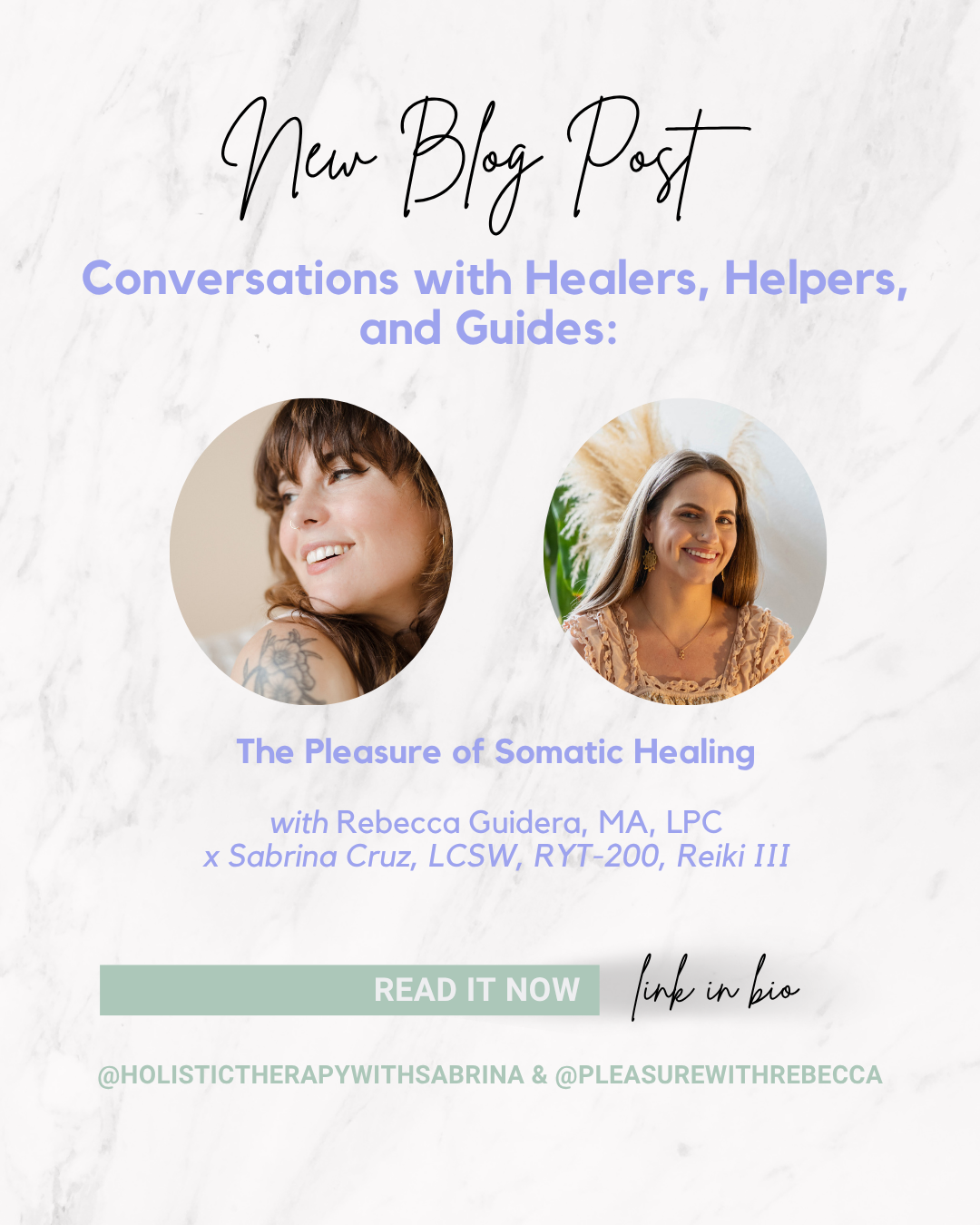
Conversations with Healers, Helpers, & Guides: The Pleasure of Somatic Healing with Rebecca Guidera, MA, LPC
Conversations with Helpers, Healers, and Guides is a monthly blog series from Holistic Healing and Wellness with Sabrina LLC to spark conversation with other wellness professionals to share perspectives on different ways mind, body, spirit health can be supported.
Today, we are talking with Rebecca Guidera, a Licensed Professional Counselor who is passionate about pleasure-focused healing.

How Trauma Affects Your Throat Chakra (And How to Reclaim Your Authentic Voice)
Your Throat Chakra is your core of authentic expression, communication, and truth. When it's balanced, you experience clarity in speaking your truth, creative expression, and the ability to listen deeply.
But when this energy center is disrupted, the impact on your daily life is huge. Feelings of being unheard, fear of judgment, and an inability to express your true self can become common. These are strong indicators that your throat chakra is out of alignment.

Matcha lattes to make at home that are (quicker) and tastier than your fav coffee shop
If you are obsessed with matcha, like me, you have to try these DIY recipes at home to make the matcha of your dreams! This blog post is a lil diff than my typical therapy/spirituality content, but let’s face it - making your fav matcha at home can be a sacred meditation.
I love getting a matcha latte here and there, but I prefer to make it at home because I know what’s in it, it’s special to prepare it myself, and it saves me $7-10/cafe matcha.
How Trauma Affects Your Heart Chakra (And How to Receive Love, Empathy, and Connection)
Your Heart Chakra is your core of love, connection, and compassion. When it's balanced, you experience deep empathy, open-heartedness, and the ability to give and receive love freely.
But when this energy center is disrupted, the impact on your daily life is significant. Feelings of isolation, difficulty with boundaries, and an inability to forgive can become common. These are strong indicators that your heart chakra is out of alignment.
Your Complete Guide on How to Use Out-of-Network Benefits for EMDR
I get it. Finding a therapist who's truly the right fit can feel like searching for a needle in a haystack. You hop on Psychology Today or Google, and suddenly there are hundreds of profiles in your area. Maybe a friend raves about their therapist, but you're still left wondering: Do I even need therapy? How often will I have to go to feel better? Does my insurance actually cover this?
These are all incredibly common questions, and honestly, I've been there myself, sitting in the client's chair. Insurance lingo can be tricky to untangle, which is exactly why I put together this guide for you. My goal is to support you in your search for your dream therapist.

Why I use Reiki with EMDR as a Licensed Therapist
If you’re reading this, chances are you value a holistic and intentional approach to healing. We share similar values here. Traditional talk therapy often doesn’t go deep enough. The number one reason I use Reiki with EMDR as a licensed therapist is that trauma affects your mind, body, and spirit - so why shouldn’t your recovery focus on that too? We get to use Reiki to enhance EMDR and help you heal from the inside out.

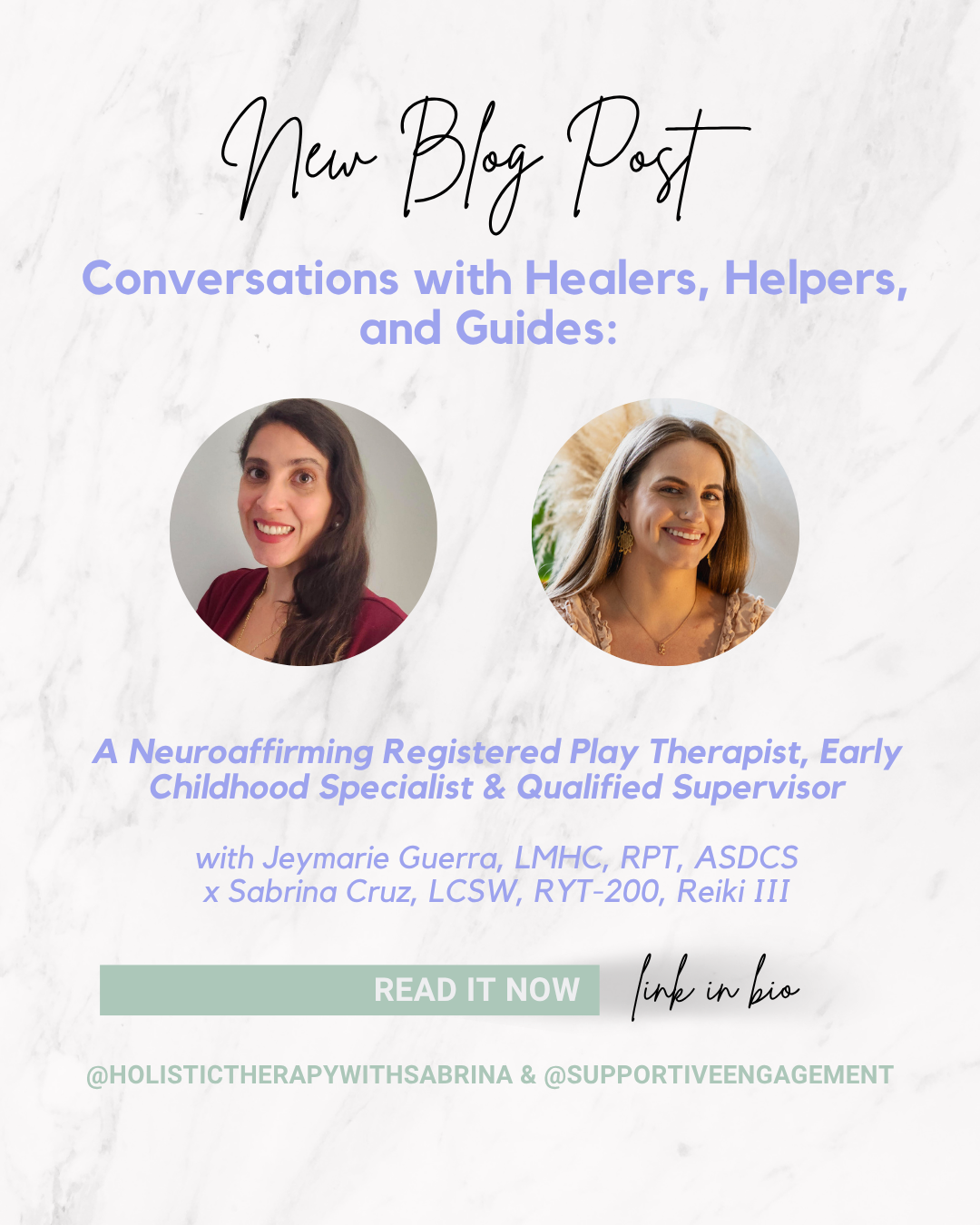
Conversations with Healers, Helpers, & Guides: Jeymarie Guerra, A Neuroaffirming Registered Play Therapist, Early Childhood Specialist & Qualified Supervisor
Today, we are talking with Jeymarie Guerra, a Licensed Mental Health Counselor who is passionate about neuro-affirming and trauma-informed care. She is a wealth of knowledge in the SOFLO community and beyond.

How Trauma Affects Your Sacral Chakra (And How to Reclaim Your Creativity, Joy, and Pleasure)
You know those days when you feel totally in your element? Like ideas are just flowing, you're laughing easily, maybe dancing in your kitchen, or just genuinely feeling good in your skin? That's your Sacral Chakra energy doing its happy dance. But then there are the other days, right? The ones where creativity feels totally blocked, emotions are stuck or overwhelming, intimacy feels distant, or joy feels... well, far away. If you've ever felt numb, stifled, or disconnected from your own inner rhythm, chances are your sacral chakra might need a little love.

From High Hopes to Deep Disappointment: The Anxious Attachment Loop
You know the feeling. You're chatting with a new friend, or a family member, and there's a moment – a shared laugh, a heartfelt comment, a feeling of genuine connection.
And just like that, your mind races ahead. This is it! This feels good. This connection is real.
You're filled with this wonderful, warm sense of hope and joy. You start to picture more moments like this. It feels amazing, doesn't it?
But then, something shifts. Maybe they seem a little busy, or a plan gets canceled, or you just get a quiet moment that feels... off.
And suddenly, that lovely, hopeful feeling twists into a familiar knot in your stomach. That joy drains right out, replaced by a heavy disappointment. Your brain, in what feels like a blink, jumps to:
"Did I say something wrong?"
"Are they pulling away?"
"Am I too much?"
"Why does this always happen to me?"
"Maybe I'm not that important to them after all."
"See? I knew it wouldn't last."